
HydroMentia’s Algal Turf Scrubber® systems have been implemented and evaluated at full-scale facilities, pilot-scale demonstrations, research installations, and regional planning assessments for municipal, agricultural, stormwater, surface-water restoration, wastewater, aquaculture, and watershed applications.
The links below provide access to selected HydroMentia ATS facilities, pilot studies, historical demonstrations, and regional planning assessments. Together, these pages document the development of ATS technology across a wide range of source waters, nutrient concentrations, hydraulic conditions, facility scales, and treatment objectives.
Projects Summary Table
Reviewers interested in comparing source-water nutrient concentrations across facilities may want to begin with the Facility Summary table. That page provides a summary of representative influent total nitrogen and total phosphorus concentrations sorted by influent phosphorus, helping place each ATS facility or pilot study in the context of the water quality it was designed to treat.
Projects Summary: Inflow Nutrient Concentrations
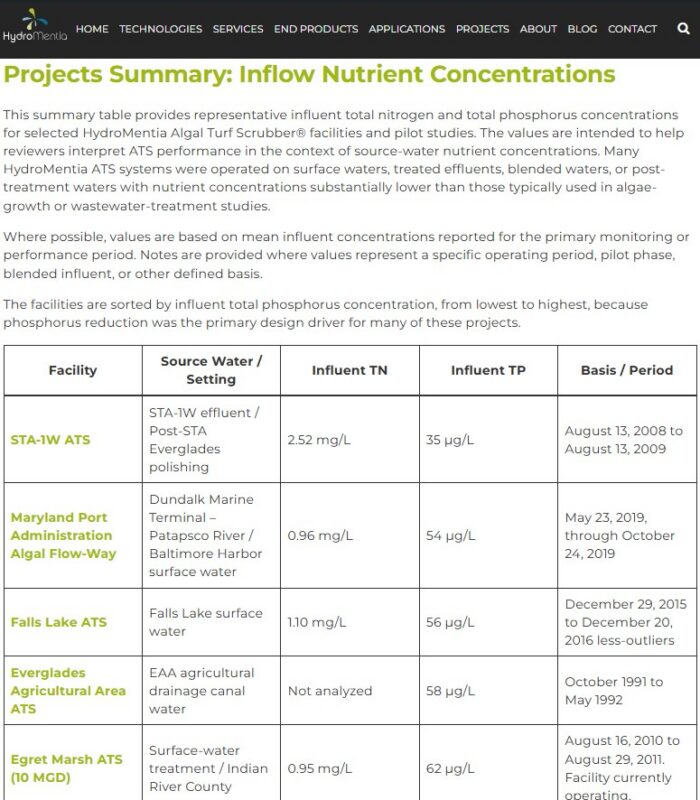
After reviewing the nutrient-concentration summary, use the facility links below to access individual project pages with additional details on facility scale, operating context, design features, performance findings, and associated reports.
Full-Scale Facilities
These facilities represent HydroMentia’s full-scale ATS and integrated aquatic plant treatment applications, including currently operating public-sector nutrient-reduction facilities and historical full-scale demonstrations.
Osprey Marsh ATS — Currently operating 10 MGD full-scale surface-water treatment facility in Indian River County, Florida, designed for nutrient reduction and recovery from a blend of canal water and reverse osmosis concentrate.
Egret Marsh ATS — Currently operating 10 MGD full-scale surface-water treatment and polishing facility in Indian River County, Florida, incorporating ATS treatment, solids recovery, ponds, wetlands, and habitat features.
Taylor Creek ATS — 15 MGD full-scale Lake Okeechobee watershed facility constructed to reduce nutrient loads from Taylor Creek, with subsequent investigation of source-water inhibition and unresolved performance issues.
Harmony Creek Aquaculture ATS — HydroMentia’s 30 MGD closed recirculating aquaculture facility in Okeechobee County, Florida, demonstrating integrated water hyacinth and ATS treatment at commercial production scale.
Pilot and Demonstration Projects
S-154 WHS-ATS — Two-stage Water Hyacinth Scrubber / ATS demonstration in the Lake Okeechobee Watershed evaluating concentration reduction, load reduction, and ATS recycle operation.
S-154 ATS — Single-pass ATS demonstration in the Lake Okeechobee Watershed comparing linear hydraulic loading rates and nutrient load reduction.
STA-1W ATS — Post-STA Everglades phosphorus-polishing pilot evaluating ATS treatment of low-phosphorus wetland effluent and simulated fine-solids recovery.
Falls Lake ATS — City of Durham pilot evaluating ATS treatment of Falls Lake surface water for nutrient reduction and reservoir water-quality improvement.
Lake Lawne In-Lake ATS — Urban lake-restoration pilot in Orlando, Florida, evaluating direct lake-water ATS treatment under early-stage operating conditions.
Powell Creek ATS — Lee County pilot evaluating ATS treatment of tidal urban drainage water influenced by stormwater runoff and Caloosahatchee Estuary backwater.
PC-South/Osprey Marsh ATS — Indian River County pilot evaluating ATS treatment of blended reverse osmosis concentrate and South Relief Canal water.
Santa Fe ATS — Suwannee River Water Management District pilot evaluating ATS treatment of Santa Fe River water under remote riverine source-water and conveyance conditions.
Maryland Port Administration Algal Flow-Way — Dundalk Marine Terminal pilot evaluating attached-algae treatment, surge versus continuous flow, floway surface materials, biomass dewatering, and anaerobic digestion.
Rockaway ATS — NYCDEP pilot at the Rockaway Water Pollution Control Plant evaluating high-rate ATS treatment of municipal wastewater plant flow.
Egret Marsh Pilot ATS — Short-duration Indian River County pilot evaluating whether Lateral C Canal water could support attached-algae growth and nutrient recovery prior to development of the full-scale Egret Marsh ATS facility.
Historical ATS Demonstrations
Everglades Agricultural Area ATS — Early outdoor ATS field demonstration in the New Hope region of the Everglades Agricultural Area evaluating phosphorus removal from agricultural drainage canal water.
Patterson ATS — Early large-scale municipal wastewater ATS demonstration at the City of Patterson wastewater treatment plant in California, evaluating tertiary polishing, nutrient removal, mechanical harvesting, filtration, and UV disinfection.
Regional Planning and Assessment Projects
Suwannee River Regional ATS Assessment — Conceptual regional assessment evaluating ATS-based nutrient reduction scenarios for the Florida section of the Suwannee River and associated springshed water-quality restoration goals.
Technology Development Context
The facilities and studies listed above reflect different stages in the development of ATS technology. Early outdoor demonstrations such as the Everglades Agricultural Area and Patterson projects helped move ATS from controlled research systems toward field-scale environmental treatment. Harmony Creek demonstrated integrated aquatic plant and ATS treatment at commercial scale. Later HydroMentia projects expanded the technology into watershed restoration, wastewater polishing, surface-water nutrient recovery, and full-scale public-sector treatment facilities.
Because each project had different source water, hydraulic conditions, treatment objectives, and monitoring basis, the facility pages should be interpreted as a technical archive rather than a single standardized performance comparison. Where available, each page provides facility scale, source-water context, influent nutrient concentrations, operating period, design features, performance findings, and links to associated reports or publications.